











Moving Epic to cloud is often viewed as a major infrastructure milestone. But the real value begins after the migration is complete and the environment is stabilized. For healthcare organizations, Epic on Cloud is not just about moving from a data center to Azure or another cloud platform. It is about creating a stronger foundation for resilience, analytics, automation, and future-ready digital health capabilities.
Once Epic workloads are operating reliably in cloud, organizations can shift from migration execution to long-term modernization.
Strengthening Disaster Recovery and Business Resilience
One of the most immediate benefits of Epic on Cloud is the ability to improve disaster recovery and business continuity. Epic is a mission-critical platform, and downtime can directly affect patient care, clinical operations, and revenue cycle workflows.
A cloud-based architecture allows healthcare organizations to design more flexible disaster recovery models, improve backup and restore capabilities, test recovery procedures more frequently, and align recovery strategies with defined RTO and RPO targets. Rather than treating DR as an annual exercise, cloud enables a more operational and repeatable resilience model.
Modernizing Reporting and Analytics
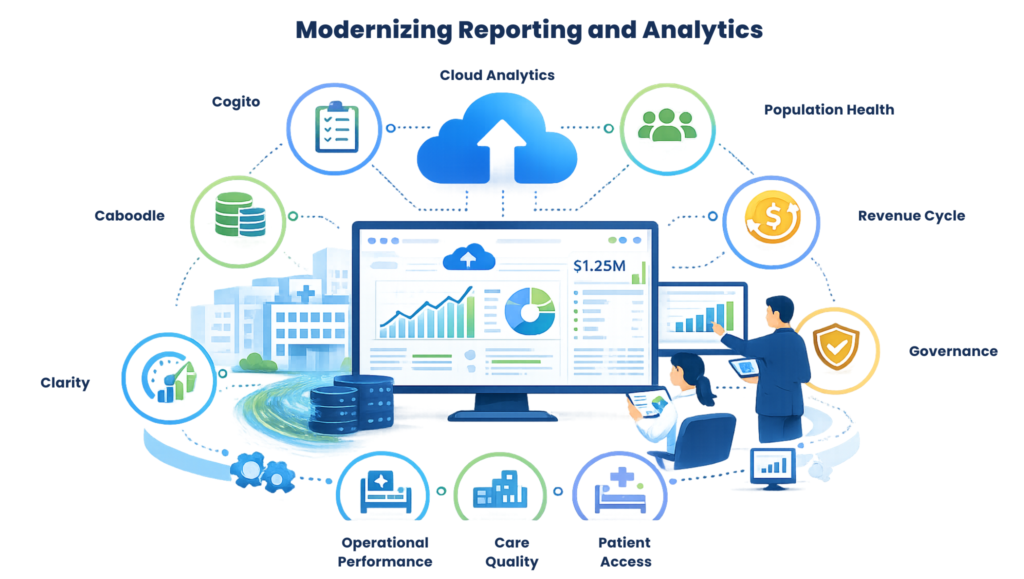
Epic environments generate massive volumes of clinical, operational, and financial data. After migration, organizations have an opportunity to modernize how they use Clarity, Caboodle, Cogito, and other reporting assets.
Cloud infrastructure can support scalable reporting, better data refresh patterns, improved performance tuning, and stronger integration with enterprise data platforms. This creates a foundation for more timely insights across care quality, patient access, revenue cycle, population health, utilization, and operational performance.
The goal should not be only to “lift and shift” reporting workloads. The real opportunity is to build a more scalable and governed analytics ecosystem around Epic data.
Improving Operational Monitoring and Security
Post-migration optimization should include stronger monitoring, observability, and security hardening. Cloud-native tools can provide better visibility into infrastructure health, system performance, access patterns, alerts, logs, and operational risks.
Healthcare organizations should focus on proactive monitoring, automated alerting, capacity management, vulnerability management, encryption, identity governance, privileged access controls, and audit readiness. This is especially important because Epic supports sensitive patient data and must operate within strict compliance expectations.
Security should not be added after migration. It should become part of the cloud operating model.
Integrating Epic Data with the Enterprise Data Platform
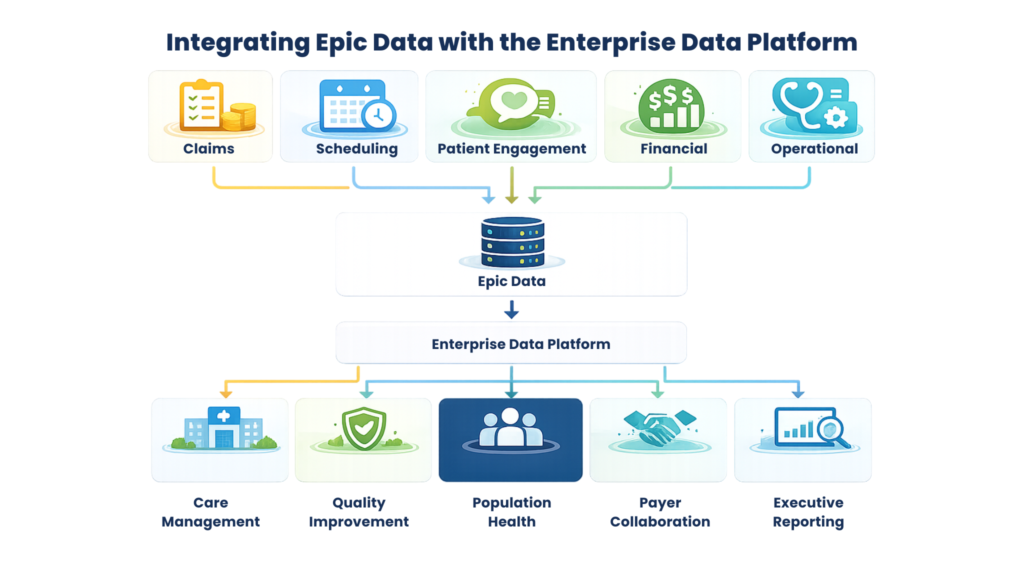
Epic on Cloud can also become a catalyst for broader data platform modernization. Organizations can connect Epic-related data with claims, scheduling, patient engagement, operational, financial, and external data sources to create a more complete enterprise view.
This enables stronger decision-making across clinical operations, care management, quality improvement, payer collaboration, and executive reporting. With proper governance, data cataloging, lineage, access controls, and interoperability standards, Epic data can become part of a larger healthcare intelligence platform.
Current AI Opportunity in Healthcare
AI is creating significant opportunities across healthcare, but its success depends on trusted data, secure architecture, and strong governance. After Epic is stabilized in cloud, organizations are better positioned to explore AI-enabled use cases such as clinical documentation support, ambient scribing, patient message summarization, revenue cycle automation, prior authorization support, predictive risk models, operational forecasting, and care gap identification.
However, AI in healthcare must be implemented carefully. The focus should be on augmenting clinicians and staff, not replacing human judgment. AI solutions must be evaluated for accuracy, bias, privacy, explainability, security, and workflow fit. Epic data, when governed responsibly, can support high-value AI use cases that improve efficiency, reduce administrative burden, and enhance patient and provider experiences.
Building a Long-Term Cloud Operating Model
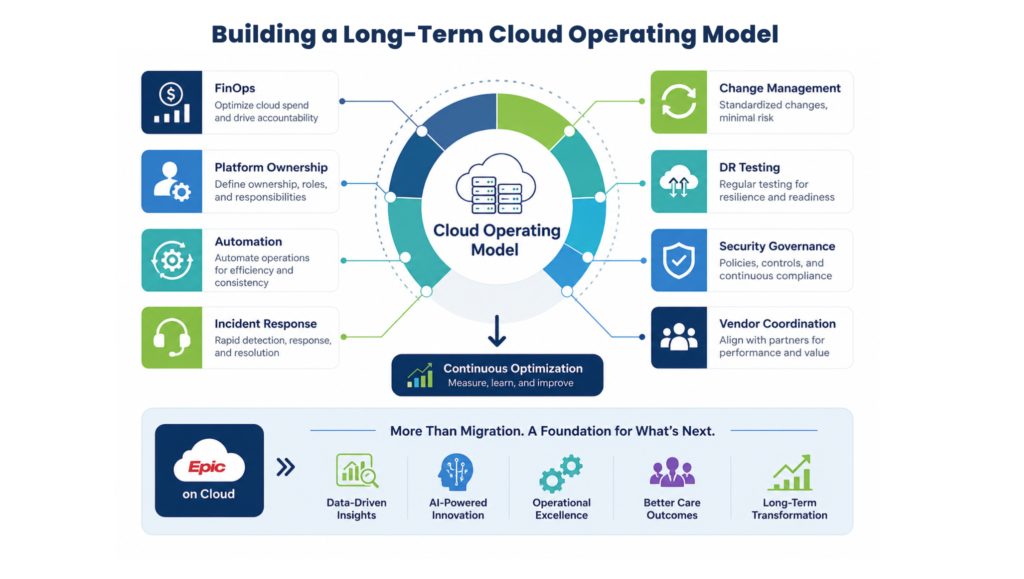
The final step is creating a sustainable cloud operating model. This includes FinOps, platform ownership, automation, incident response, change management, DR testing, security governance, vendor coordination, and continuous optimization.
Migration moves Epic to cloud. A strong operating model ensures the organization continues to gain value from that move.
Epic on Cloud should not be seen as the end of a migration journey. It is the beginning of a more resilient, data-driven, and innovation-ready healthcare technology foundation. The organizations that succeed will be those that move beyond infrastructure migration and use cloud as a platform for analytics, AI, operational excellence, and long-term healthcare transformation.