




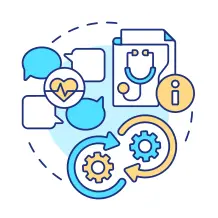




Healthcare technologies have significantly improved the way providers deliver care, manage information, and interact with patients in the modern medical environment. Such progressive solutions as EHRs, telehealth services, patient portals, and various forms of technology-assisted treatment have become widespread in clinical settings and institutions around the country. Yet, the mere use of technology is far from being sufficient to improve the patient experience.
Healthcare organizations must ensure that technology is designed around the needs, expectations, and preferences of the people using it. This is where How Healthcare Organizations Can Build More Patient Centric Technology becomes an important consideration for healthcare leaders looking to combine innovation with meaningful patient outcomes.
What Is Patient Centric Healthcare Technology?
Patient-centric technology is technology that places the patient at the center or makes the healthcare experience more accessible, comprehensible, personalized and convenient. It puts care around the individual and less on the administrative and technical aspects of the system.
A patient-centric approach considers questions such as:
- Is the technology easy for patients to use?
- Can patients access their health information when they need it?
- Does the solution support different levels of digital literacy?
- Can patients communicate effectively with their care teams?
- Does the technology help patients make informed decisions?
Answering these questions can help organizations move beyond technology adoption toward technology that genuinely improves the patient journey.
1. Design Around the Patient Journey
Health care organizations should start by defining the entire patient journey and not the set of technologies.
A patient journey may consist of finding a provider, scheduling and attending an appointment, registering, having a virtual or in-person examination, reviewing test results, communicating and discussing a diagnosis and treatment plan, being billed for services, and receiving follow-up care in a hospital or at home.
Technology should support and unify the set of diverse journeys that patients go through when receiving care, as opposed to creating various digital touchpoints that require patients to go through different stages.
For instance, patients should not be obliged to provide the same information repeatedly in different software. Creating a seamless continuum of care throughout the journey is essential, which can be done by unifying scheduling, registration, clinical information, communication, and follow-up processes.
2. Make Health Information Easier to Access and Understand
Patients are demanding convenience in accessing their health data. Patient portals and medical related applications offer patients access to laboratory results, medications, appointment details, care plans and medical records.
However, accessibility is not sufficient. Information can be presented in different ways and patients need to understand the information.
Healthcare organizations need to make information relevant to patients in a user-friendly format such as simplified language, navigable online resources, graphical representations and contextual information to help them come to terms with their health data. Patients are more likely to be involved in managing their health if they have a good understanding of their health status.
3. Strengthen Interoperability
Patient-centric considerations are dependent on connected healthcare systems
Without proper exchange of information between EHRs, laboratories, pharmacies, health information exchanges, patient engagement tools, and other systems, patients risk receiving delayed, disparate, or fragmented care. Healthcare organizations should strive to adopt interoperability standards such as HL7 FHIR to exchange relevant patient information securely and achieve meaningful use of health data.
Enhanced interoperability will enable clinicians to access the information they need at the point of care while providing patients with a clear perspective of their healthcare needs.
4. Personalize Digital Healthcare Experiences
Patients have different needs, communication preferences, languages, accessibility needs, and levels of digital literacy. One-size-fits-all technology approaches to healthcare may actually create barriers to care.
Organizations can use information about patient preferences and needs to personalize digital encounters. For example, patients could be given options about how they want to communicate or receive reminders and education materials.
AI can play a role in personalizing care by identifying patterns and recommendations. But clinicians still have an important role to play in making recommendations to patients.
5. Prioritize Accessibility and Inclusion
Patient-centric technology should be designed to serve a diverse patient population.
Organizations developing technologies should take into account individuals with disabilities, elderly patients, those with limited technological proficiency, people who speak different languages, and those without access to advanced technologies such as high-speed internet and cell phones.
By providing accessible interfaces, multilingual customer service, mobile-friendly websites, voice recognition, and easy navigation, organizations can make healthcare more accessible to populations that may have trouble using digital services.
Modern technology should help to bridge the gap between patients and caregivers, instead of creating a divide.
6. Build Trust Through Security and Privacy
Patient-centric technology should also be reliable. The organization handles the patient’s personal and sensitive information. Therefore, the company must ensure privacy and cybersecurity measures to protect the data from unauthorized access.
The healthcare organization must employ authentication, encryption, access control, monitoring, and governance tools to enhance information security. The company should also inform the patient about the data the organization collects, its usage, sharing, and protection.
Patients will trust the company when they know their information is in safe hands. As a result, they will provide relevant information through technology to help improve their care delivery.
7. Use Patient Feedback to Improve Technology
Technology should not be seen as a one-time application and healthcare providers should constantly seek to improve patients’ interaction with it.
Using surveys, testing, feedback, interviews, and analyzing engagement, businesses can get honest feedback.
They can use this information to enhance the interface, make their work easier for patients in other ways, and see what developments should be prioritized. Patients should be engaged and able to influence the design of the technology at an early stage, not only after the technology is deployed.
8. Measure Outcomes, Not Just Adoption
A healthcare organization should not define digital success simply by the number of users registered on a platform.
More meaningful measures may include:
- Patient satisfaction and engagement
- Appointment completion rates
- Portal utilization
- Time required to complete digital tasks
- Medication adherence
- Care coordination outcomes
- Patient-reported outcomes
- Reduction in administrative friction
These metrics can help organizations determine whether technology is actually improving the patient experience.
Partner with ClinDCast for More Patient Centric Healthcare Innovation
Building patient-centric technology requires more than implementing digital solutions. Healthcare organizations need the right combination of healthcare expertise, interoperability, data strategy, and continuous optimization.
ClinDCast helps organizations navigate this transformation through healthcare technology solutions spanning EHR services, interoperability, data conversion, analytics, and digital health innovation. By connecting systems, improving data accessibility, and aligning technology with healthcare workflows, ClinDCast helps create more efficient and patient-focused experiences. As healthcare evolves, the right technology strategy can make care more connected, personalized, accessible, and meaningful for both patients and providers.