












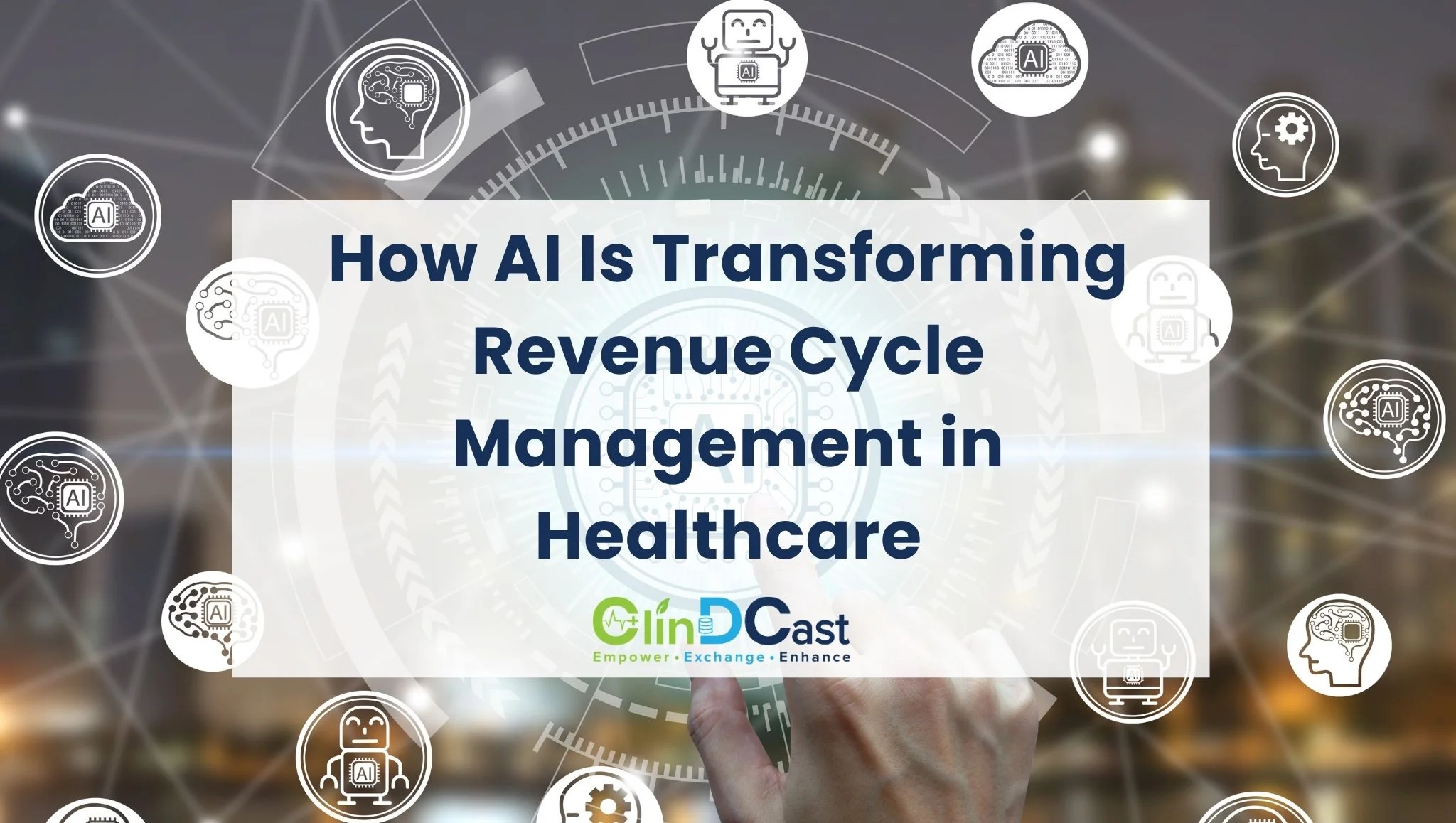
As healthcare organizations manage increasing administrative complexity, rising operational costs, and growing volumes of financial and clinical data, artificial intelligence is becoming an important technology for improving revenue cycle operations.
How AI Is Transforming Revenue Cycle Management in Healthcare is no longer simply a question of future possibilities AI is increasingly being applied to areas such as claims processing, medical coding, denial management, eligibility verification, and revenue analytics. By combining AI with automation and healthcare data, organizations can streamline repetitive workflows, identify potential issues earlier, and make revenue cycle processes more efficient.
What Is AI-Powered Revenue Cycle Management?
Revenue Cycle Management (RCM) encompasses the processes involved in clinical care and the reimbursement procedures for those services. Commonly, RCM involves patients’ registration, insurance verification, medical coding, submission of claims to insurers, posting payments, denial management, and collections. With the help of AI in healthcare, RCM processes can benefit from the use of technology such as machine learning, natural language processing, predictive analytics, and intelligent automation. These innovative approaches can complement the traditional manual auditing of processes.
Instead of the traditional auditing and analysis of transactions, AI can process millions of structured and unstructured data to identify trends, problem areas, and opportunities for optimization in revenue cycle management.
AI can support areas such as:
- Patient eligibility verification
- Medical coding
- Claims processing
- Denial management
- Prior authorization
- Payment posting
- Revenue forecasting
- Revenue leakage detection
- Patient financial communication
1. Automating Patient Eligibility Verification
Insurance eligibility verification is an important early stage of the revenue cycle. Wrong insurance information, inactive coverage, or any other data discrepancies may lead to claim rejections and unexpected patient expenses.
AI can be used to assess patient and insurance data, detect potential issues and facilitate the automated verification process. Being able to identify eligibility problems before services are rendered can help reduce downstream claim rejections and prevent unnecessary administrative headaches.
2. Improving Medical Coding
Medical coding consists of analyzing clinical documentation and accurately assigning diagnosis, procedure, and other codes. AI and NLP technologies can be used to analyze clinical documents, identify diagnoses and procedures, and other relevant information for coding. AI-enabled coding solutions could help coding professionals in identifying the potential codes, recognizing missing information, and prioritizing the documents that need attention.
While AI coding solutions could automate some of the routine and rule-based aspects of coding, they are not intended to replace the need for skilled coding professionals. On the contrary, AI solutions could help to free up coding experts from some of the more mundane tasks and allow them to focus on more complex cases that require human expertise.
3. Predicting and Preventing Claim Denials
Claims denial may turn out to be very costly and time-consuming for healthcare providers. Using predictive analytics to study denied claims’ patterns can improve the revenue cycle. For example, it can help in reducing the number of denied or rejected claims. There are several reasons for claims denial, including coding errors, missing or incomplete documentation, payer-specific requirements, and lack of pre-certification.
Therefore, predictive models can be used to anticipate claims that have a higher possibility of being denied and help the revenue cycle management team deal with them more efficiently. In this way, RCM can change from responding to denials to preventing them.
4. Supporting Prior Authorization
Prior authorizations represent another domain in which healthcare organizations have to navigate through excessive administrative hurdles.
The application of AI can assist in streamlining the requirements, detecting missing or incomplete documentation, retrieving the relevant information from medical records, and automating the process.
By integrating such software into the EHR and other systems, the administrative burden can be significantly reduced by eliminating repetitive tasks, thus, improving the overall efficiency of the authorization mechanism.
5. Identifying Revenue Leakage
Revenue leakage can occur when organizations fail to capture appropriate reimbursement for services provided.
AI-powered analytics can examine large amounts of financial and claims data to identify unusual patterns and potential discrepancies.
For example, AI can help identify:
- Missing charges
- Incorrect coding
- Underpayments
- Unresolved claims
- Contractual discrepancies
- Repeated billing errors
These insights can help revenue cycle teams investigate potential sources of lost revenue and strengthen financial processes.
6. Improving Revenue Forecasting
Besides, artificial intelligence can help in revenue forecasting by examining the history of claims and payments and other financial facts.
By using predictive analytics, organizations can anticipate reimbursements, forecast cash-flow needs, and make other financial projections. Through this, instead of randomly guessing, an organization can rely on facts, data, and information for its financial planning.
7. Enhancing the Patient Financial Experience
RCM is not only about the organization’s finances but also the patient experience. The use of AI could facilitate reminders, personalized communication, electronic payments, and self-service tools.
For instance, smart technology could be utilized to personalize communication based on the patient’s account and service needs. A more efficient financial process could improve the overall experience while reducing administrative stress and educating the patient on their financial obligation.
Challenges of Implementing AI in RCM
While AI offers significant opportunities, healthcare organizations need to address several considerations before implementing AI-powered RCM solutions.
- Data quality: AI depends on accurate and consistent data.
- System integration: AI solutions need to integrate with EHRs, billing platforms, payer systems, and other healthcare applications.
- Privacy and security: RCM involves sensitive patient and financial information, making data protection and appropriate security controls essential.
- Human oversight: AI recommendations should be reviewed appropriately, particularly for complex coding, claims, and financial decisions.
- Change management: Employees need training and clearly defined workflows to use AI effectively.
The Future of AI in Healthcare RCM
The future of revenue cycle management is shifting towards being more predictive, automated, and data-driven. With the help of AI, organizations can prevent billing and payment errors before they occur.
The convergence of AI, automation, EHRs, interoperability, and healthcare data analytics will lead to more connected and integrated RCM solutions. As these technologies evolve, the focus will be on achieving the right mix of automation and manual processes, along with governance, to ensure financial integrity, quality of care, and data privacy and security.
How ClinDCast Helps with Revenue Cycle Management
We offer healthcare organizations Revenue Cycle Management consulting and solutions to help them boost performance via healthcare IT expertise, data integration, automation, interoperability, and analytics. With the help of such technologies as AI, Application Programming Interfaces, HL7, FHIR, and others, we help clinics optimize their claim management, denial management, electronic health records, analytics, and other revenue cycle processes to achieve more efficient operations and increase bottom-line performance.