For healthcare organizations, Epic to Cloud migration is not just a technology move. It is a clinical, operational, financial, and security transformation that must begin with organizational readiness.
Epic is one of the most mission-critical platforms in a healthcare organization. It supports clinical documentation, patient access, revenue cycle, medication workflows, reporting, analytics, interoperability, and many day-to-day care delivery processes. Because of this, migrating Epic to Cloud should never be treated as a simple infrastructure relocation. It requires a disciplined readiness approach that protects patient care continuity while preparing the organization for cloud modernization.
Conducting a Comprehensive Current State Assessment
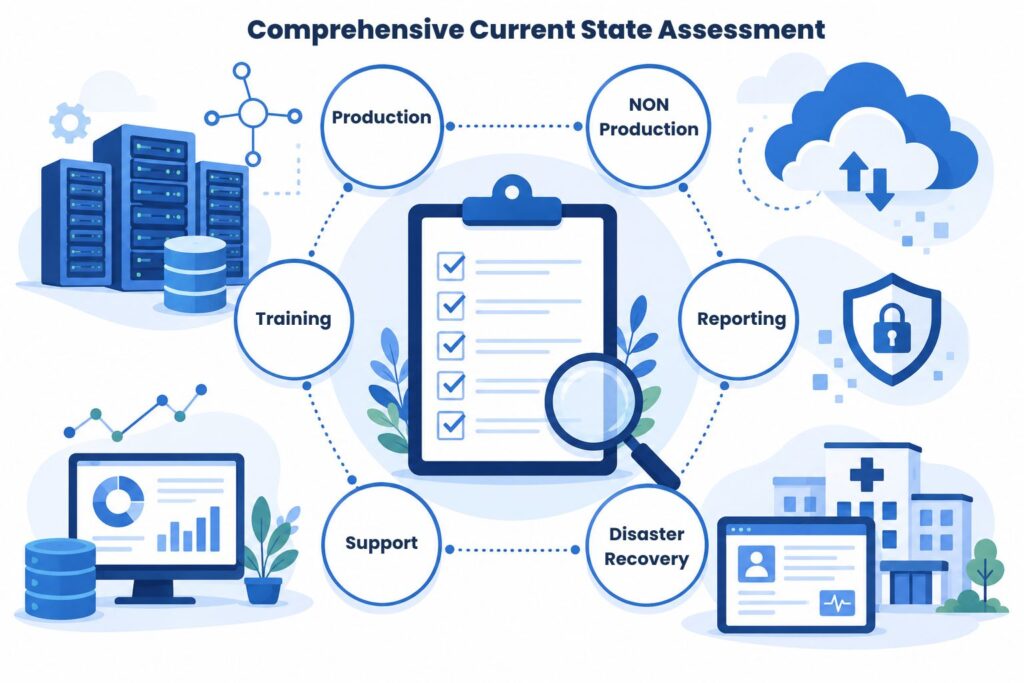
The first step is a comprehensive current state assessment. Healthcare organizations need a clear inventory of all Epic environments, including production, non-production, training, support, reporting, and disaster recovery environments. This assessment should include ECSA, ODB, Clarity, Caboodle, Cogito, Interconnect, Care Everywhere, interface engines, file shares, print services, monitoring tools, backup platforms, and DR processes.
Understanding Infrastructure Dependencies
Equally important is understanding the infrastructure beneath Epic. Teams should document current compute, storage, database, network, latency, firewall, DNS, certificate, and load-balancing dependencies. Many Epic ecosystems have years of accumulated integrations and operational workarounds. These hidden dependencies can become major migration risks if they are not discovered early.
Defining Clear Business and Migration Goals
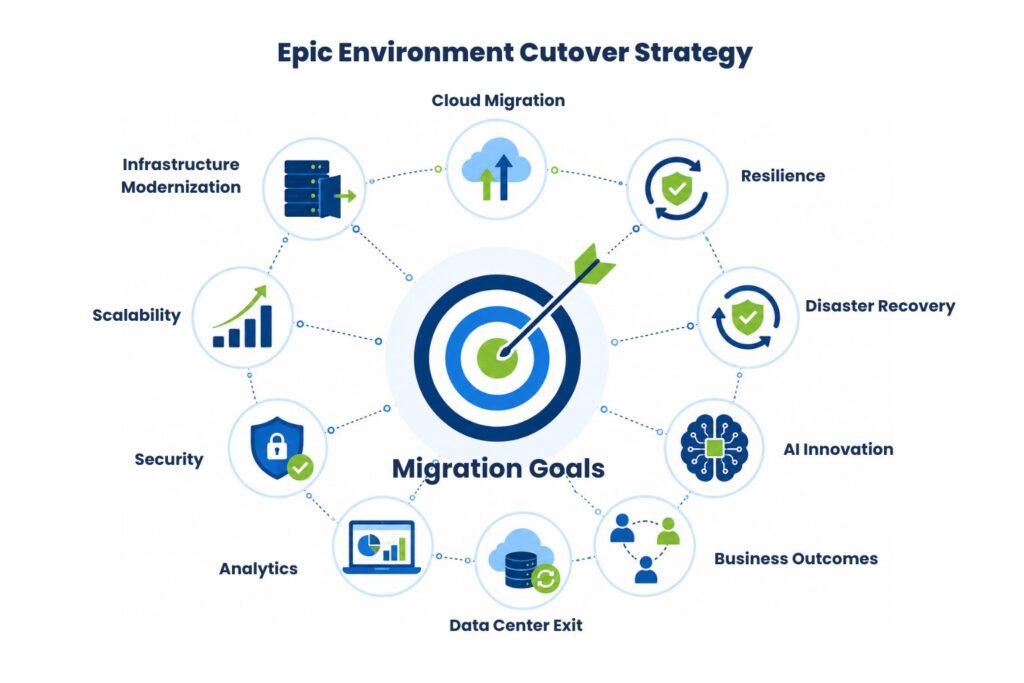
Readiness also requires clear business and migration goals. Leaders should define why the organization is moving Epic to any cloud (say Azure cloud). Is the goal to exit a data center, improve resilience, strengthen disaster recovery, reduce infrastructure aging risk, modernize security, enable analytics, improve scalability, or prepare for AI-driven innovation? Without clear goals, migration programs can become technical exercises without measurable business outcomes.
Establishing Success Criteria Early
Success criteria should be defined before migration execution begins. These may include acceptable downtime windows, RTO and RPO targets, performance benchmarks, interface validation thresholds, cost targets, security requirements, and timelines for decommissioning legacy infrastructure. Prem is especially important because running on-prem and cloud environments in parallel can be expensive. The faster an organization can safely reduce the hybrid period; the sooner it can realize operational and financial value.
Gathering Cross-Domain Readiness Information
Healthcare organizations should also collect detailed information across application, data, integration, network, identity, compliance, and operational domains. This includes application dependency maps, data volumes and growth trends, interface flows, Corepoint or any other integration engine dependencies, network topology, ExpressRoute requirements, identity and access models, privileged access processes, encryption standards, audit logging needs, HIPAA requirements, HITRUST alignment, vendor dependencies, known pain points, and skill gaps.
Building Strong Governance and Stakeholder Alignment
Governance is another critical readiness pillar. Epic to cloud migration requires alignment across Epic application teams, infrastructure, cloud engineering, cybersecurity, compliance, clinical operations, revenue cycle, analytics, finance, vendor partners, and executive leadership. A migration steering committee should define decision rights, risk management processes, escalation paths, communication plans, and cutover governance.
Planning the Epic Environment Cutover Strategy
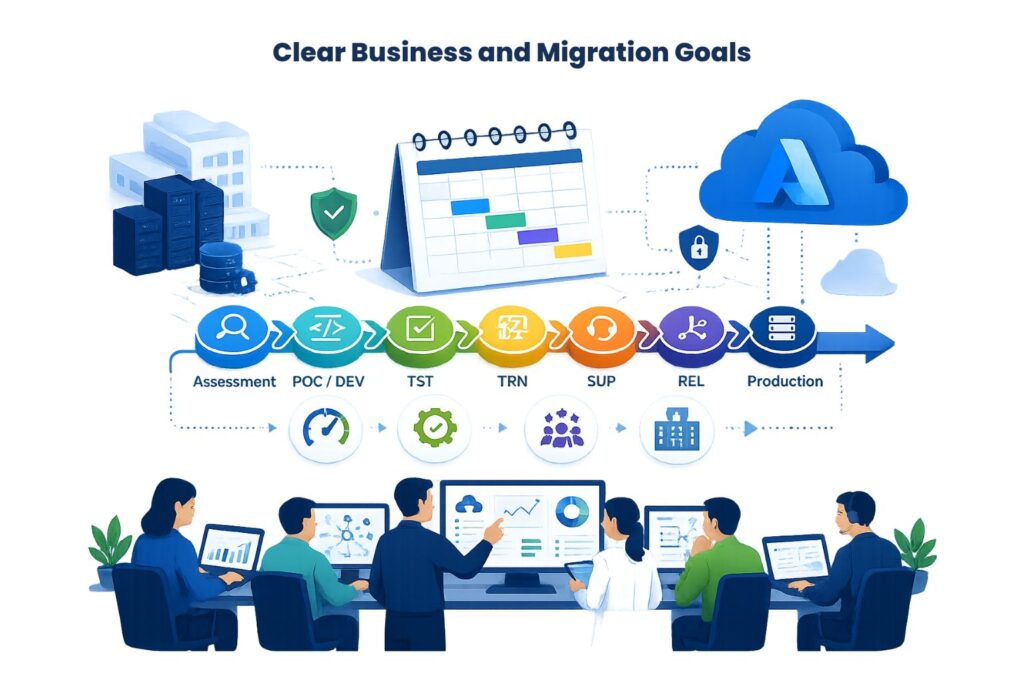
Planning the cutover schedule for various Epic environments is critical because each environment validates a different layer of migration readiness before production. Lower environments like POC, DEV, TST, TRN, SUP, and REL help teams test infrastructure, integrations, security, performance, and operational workflows early. A phased schedule reduces production risk by turning each environment migration into a rehearsal for the final cutover.
It also helps coordinate Epic teams, Azure engineers, interface teams, database teams, clinical stakeholders, and command center support. Most importantly, a disciplined cutover schedule minimizes downtime, shortens the costly parallel-run period, and protects patient care continuity.
Readiness Drives Successful Cloud Transformation
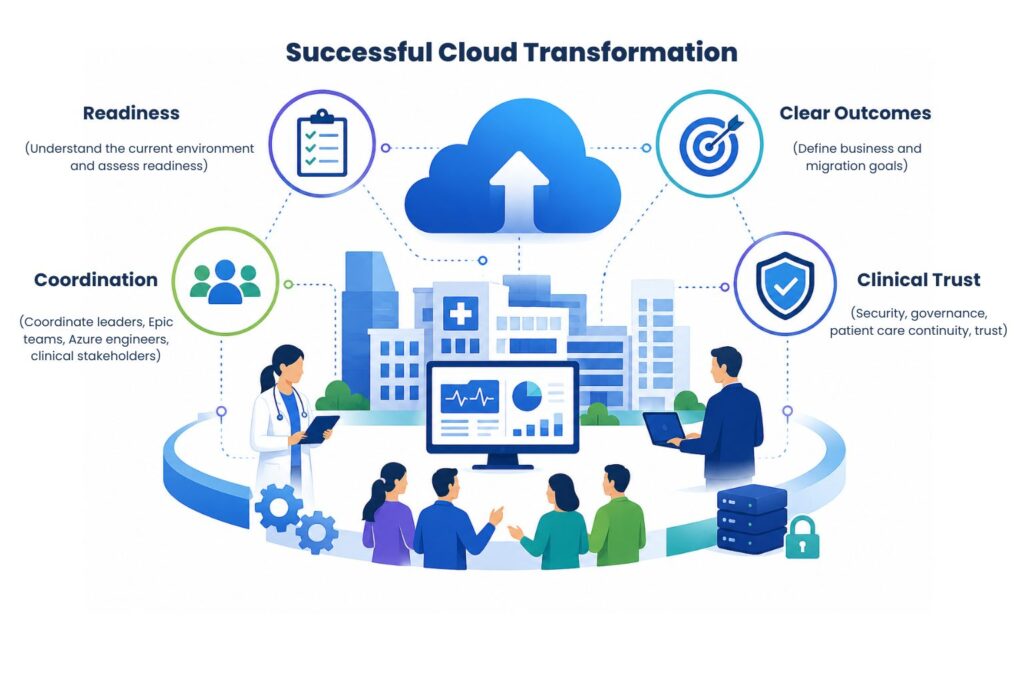
The best Epic to cloud program is not built around technology alone. They are built around readiness, discipline, accountability, and clinical trust. Organizational readiness reduces migration risk, improves decision making, shortens the costly parallel-run period, and creates a safer path to Epic cloud modernization. Before moving workloads to Azure, healthcare leaders must understand their current environment, define clear outcomes, align stakeholders, and prepare the organization for a cloud-enabled operating model.