











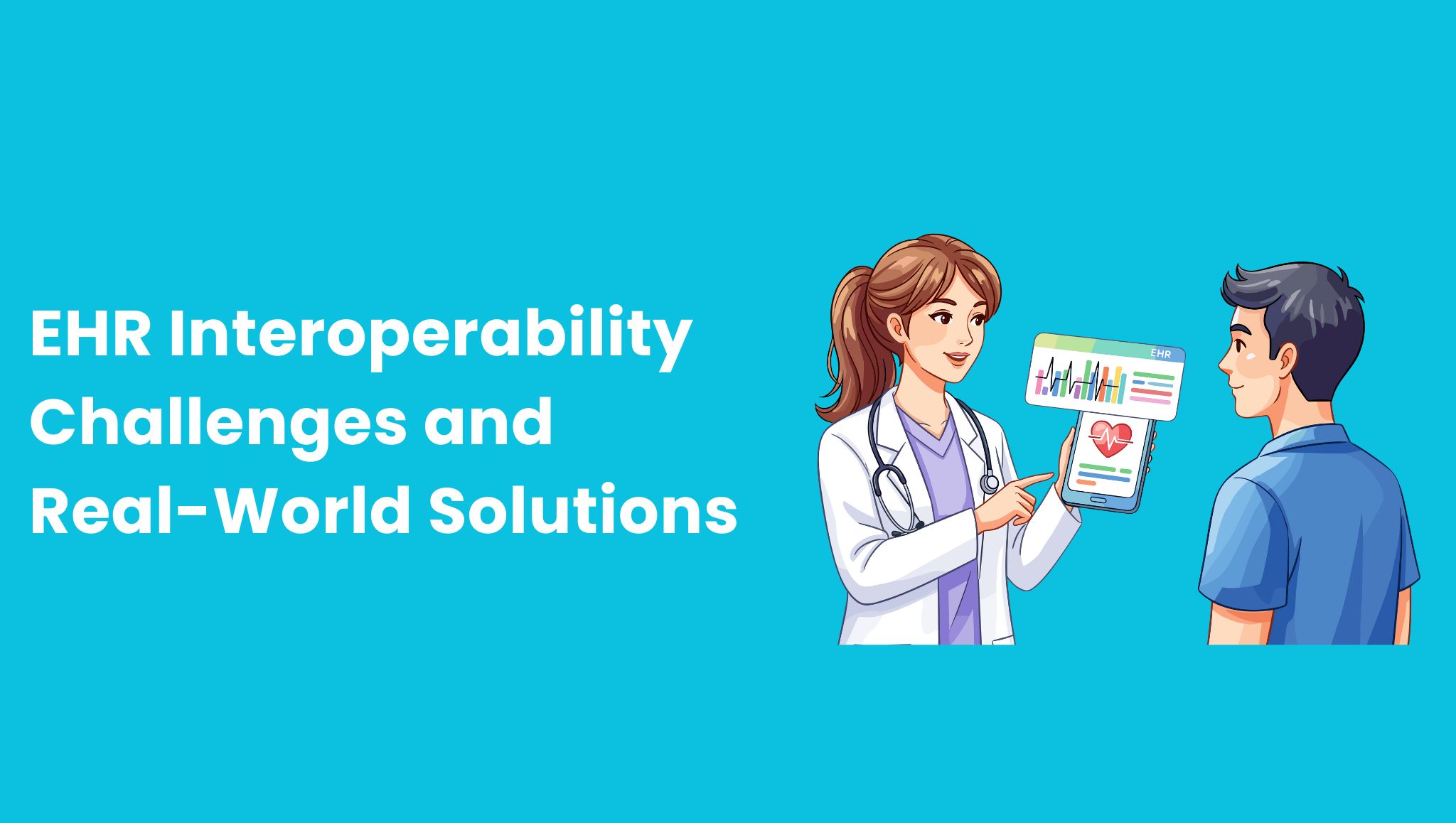
Electronic Health Records (EHRs) were designed to make patient information easier to access, reduce administrative burden, and improve coordination across the care continuum. While they have delivered meaningful benefits, true interoperability is still a significant hurdle for healthcare organizations around the world. Persistent data silos, inconsistent standards, security and privacy concerns, and organizational resistance continue to stand in the way of seamless information sharing.
Even with regulatory momentum and modern technologies like FHIR-based APIs, many clinicians still struggle to access complete and accurate patient data when and where they need it most. As a result, gaps in information can impact clinical decisions, slow workflows, and affect patient outcomes. This blog takes a closer look at the most common EHR Interoperability Challenges and Real-World Solutions that healthcare organizations can start implementing today.
Key EHR Interoperability Challenges
a) Fragmented systems and legacy platforms – Healthcare organizations often rely on multiple systems for clinical care, billing, imaging, labs, and specialty services, but many legacy platforms were not designed to work together, creating data silos and requiring costly, complex integrations.
b) Inconsistent data standards – Even when systems exchange data, variations in coding standards and formats can cause confusion, and without true semantic alignment, important clinical meaning may be lost, reducing data trust and usability.
c) Privacy, security, and consent management – While protecting patient data is essential, managing consent, secure access, and audit trails under strict regulations adds complexity and can slow interoperability efforts.
d) Patient identity and matching issues – Accurately matching patient records across systems remains difficult due to inconsistent demographics, duplicate records, and data entry errors, increasing the risk of incomplete information and safety concerns.
e) Vendor lock-in and proprietary technologies – Some EHR vendors use proprietary data models or restricted APIs, limiting flexibility, increasing integration costs, and slowing innovation and third-party adoption.
f) Organizational and governance challenges – Interoperability is not just a technical issue, as weak governance, unclear data ownership, and misaligned stakeholder incentives often delay progress.
g) Data quality and clinical usability – Unstructured data, incomplete documentation, and missing context reduce the value of shared information, limiting its usefulness for clinicians and analytics teams.
Real-World EHR Interoperability Solutions
1. FHIR-based interoperability
HL7 FHIR makes healthcare data exchange more consistent and efficient by using standardized, API-driven approaches built on modern RESTful services. It simplifies integrations between systems, supports real-time access to clinical information, and enables scalable ecosystems where applications can be developed and deployed more easily across healthcare platforms.
Practical implementation
a) Implement core resources: Patient, Observation, Medication, Condition
b) Secure APIs with OAuth 2.0 and OpenID Connect
c) Enable SMART on FHIR for application integration
2. Standardized clinical terminologies
Standard clinical terminologies help maintain consistent clinical meaning across different systems, making shared data easier to understand and trust. By enabling true semantic interoperability, they support safer, more accurate clinical decision-making across care settings.
Practical implementation
a) Use SNOMED CT for diagnoses and conditions
b) Apply LOINC for labs and observations
c) Adopt RxNorm for medications
3. Integration engines and middleware
Integration engines serve as translators and coordinators between different systems, helping data flow smoothly across platforms. By reducing the need for complex point-to-point integrations, they improve overall system reliability and make interoperability easier to manage.
Practical implementation
a) Deploy an integration engine for routing and transformation
b) Normalize data into a canonical data model
c) Monitor interfaces with alerts and logging
4. Event-driven and bulk data exchange
Event-driven and bulk data exchange approaches support real-time clinical workflows while also handling large-scale data needs. They enable timely updates for care delivery and provide the volume of information required for analytics, research, and public health reporting.
Practical implementation
a) Use FHIR Subscriptions for real-time updates
b) Implement FHIR Bulk Data for population exports
c) Use event streams for scalable processing
5. Enterprise patient identity management
Strong patient identity management helps ensure records are accurately matched across systems, creating a safe and reliable longitudinal view of a patient’s health history. This reduces errors and supports better clinical decisions over time.
Practical implementation
a) Implement MPI or EMPI solutions
b) Use probabilistic matching techniques
c) Standardize demographic data capture
6. Secure data exchange and consent management
Secure exchange frameworks protect patient data while supporting compliant and trusted interoperability.
Practical implementation
a) Encrypt data at rest and in transit
b) Apply role-based and scope-based access
c) Maintain audit trails and consent controls
Organizational and Governance Solutions
a) Interoperability governance models – Establishing cross-functional governance that brings together clinical, IT, legal, and compliance teams helps create alignment across the organization. Clear policies for data access, ownership, and accountability are essential for sustainable interoperability.
b) Use-case driven implementation – Focusing on high-impact workflows such as care transitions, medication reconciliation, or lab result exchange allows organizations to see value quickly. Early wins build confidence and create momentum for broader efforts.
c) Data stewardship programs – Assigning domain-specific data stewards ensures clear ownership of data definitions, ongoing quality monitoring, and continuous improvement over time.
d) Vendor and contract strategy – Embedding interoperability requirements into vendor contracts, including open APIs, data portability, and adherence to standards like FHIR, helps reduce long-term integration barriers and supports flexibility.
Policy and Ecosystem-Level Enablers
a) National and regional interoperability frameworks – Government-led mandates and certification programs help align providers and vendors around shared standards, expectations, and accountability, creating a more consistent interoperability landscape.
b) Health Information Exchanges (HIEs) – HIEs support data sharing across organizations by offering shared infrastructure, governance, and consent management. Successful HIEs prioritize long-term sustainability and strong clinician engagement.
c) Measurement and outcomes tracking – Tracking outcomes such as reduced duplicate testing, faster record access, and improved care coordination helps demonstrate value and supports continued investment in interoperability.
Real-World Lessons Learned
Organizations that succeed in interoperability typically:
a) Use FHIR as a canonical data layer over legacy systems
b) Prioritize governance and stakeholder alignment early
c) Focus on measurable clinical and operational outcomes
d) Expand gradually after proving value with targeted use cases
Quick Action Checklist for Healthcare Leaders
a) Identify 1–2 high-value interoperability use cases
b) Implement a FHIR-based API layer
c) Standardize terminologies and assign data owners
d) Establish interoperability governance
e) Track and report measurable outcomes
ClinDCast Perspective
Interoperability is an ongoing journey rather than a one-time initiative. Achieving lasting success requires the right balance of standards, technology, governance, and effective execution. ClinDCast helps healthcare organizations move forward with FHIR adoption, strong interoperability architectures, and outcome-driven implementation strategies designed to scale.