





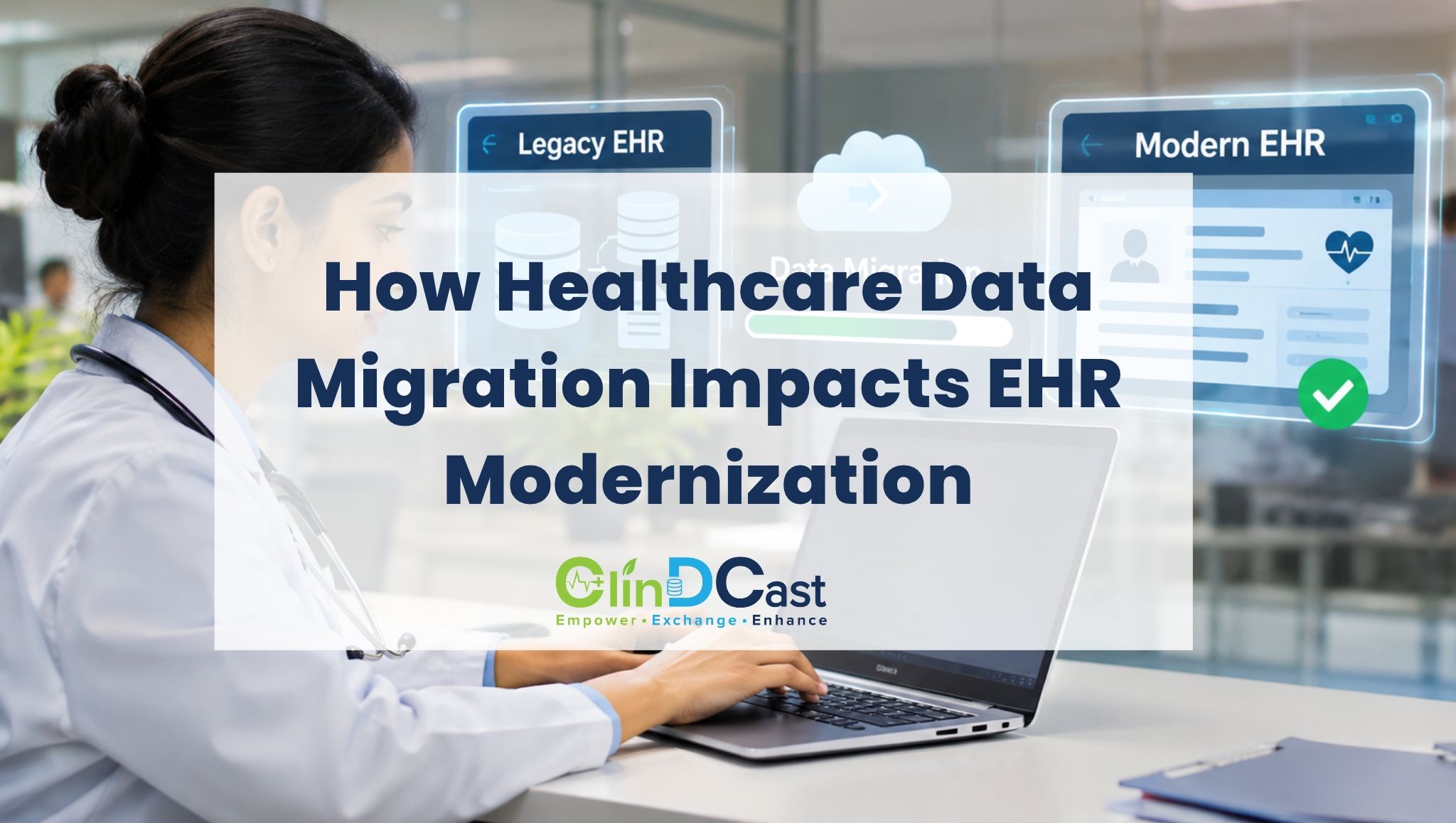
How Healthcare Data Migration Impacts EHR Modernization is an important topic as healthcare organizations transition from legacy systems to advanced Electronic Health Record (EHR) platforms. Modernizing healthcare technology involves more than adopting new software; it also requires transferring existing patient information securely and accurately.
Hospitals and healthcare providers manage large amounts of clinical and administrative data across legacy EHR systems, electronic medical records (EMRs), laboratory applications, and billing databases. Migrating this information while maintaining its accuracy and accessibility is essential for continuity of care.
Healthcare data migration supports this transformation by preserving patient records, improving interoperability, streamlining clinical workflows, and building a reliable foundation for modern healthcare technology.
What Is Healthcare Data Migration?
Healthcare data migration is the process of transferring patient records, clinical information, and administrative data from existing healthcare systems into new platforms.
It commonly involves migrating:
- Patient demographics and medical histories.
- Clinical notes and encounter records.
- Medication and allergy information.
- Laboratory results and diagnostic reports.
- Insurance and billing information.
- Immunization and treatment records.
The objective is not simply to move data but also to preserve its accuracy, structure, and clinical relevance within the new EHR environment.
5 Ways Healthcare Data Migration Impacts EHR Modernization
1. Improves Patient Data Accuracy and Integrity
Accurate patient data is critical in making clinical decisions. Issues such as incomplete medical history, incorrect medication details and duplication can be problematic.
A systematic approach to data migration will include cleaning, mapping and validating of data to identify inconsistencies.
Keeping the data accurate ensures clinicians have access to accurate patient history and can provide safe and informed care.
2. Enhances Healthcare Interoperability
Nowadays, exchanging information between hospitals, laboratories, pharmacies and other healthcare providers is essential.
Legacy systems often have different formats and standards of information which makes integration challenging.
Healthcare data migrations allow information to be standardized to be suitable for modern systems using technologies such as HL7 V2, Clinical Document Architecture (CDA) and HL7 FHIR.
For example, Health Information Technology (HIT) such as APIs based on HL7 FHIR can assist with sending structured information between EHR systems and external healthcare applications.
3. Reduces Dependence on Legacy Systems
Legacy EHR software will often become outdated or lack many features.
They also become difficult to integrate, and will require more work to maintain.
EHR solutions will provide an improved interface, scalable, automated and integrated to help your organisation keep up with the new healthcare technologies.
4. Streamlines Clinical Workflows
Healthcare professionals need efficient access to accurate patient data. If the data is stored across many systems, clinicians can waste time trying to find medical history, past interactions and results.
A smooth transition of data into your EHR will mean that important data is readily available.
Reduces unnecessary admin, ensures data is easily accessible and means healthcare professionals can spend more time providing patient care.
5. Supports Healthcare Analytics and Reporting
Quality data is essential for accurate and reliable healthcare analytics.
Organizations can clean and standardize data during the EHR modernization process.
Once data has beened it can be used to monitor clinical performance, population health management, regulatory reporting, operational analysis and data driven decisions.
Common Challenges in Healthcare Data Migration
Despite its benefits, healthcare data migration involves several challenges:
- Data Inconsistency: Legacy systems may contain duplicate, incomplete, or outdated patient records.
- Complex Data Mapping: Different EHR platforms organize clinical information differently, making accurate mapping essential.
- Data Loss: Inadequate migration procedures can result in missing or incorrectly transferred information.
- Security and Compliance: Patient information must remain protected through secure transfer methods, encryption, and appropriate access controls.
- System Compatibility: Integrating older applications with modern platforms may require additional transformation and interface development.
Addressing these challenges requires collaboration between healthcare IT specialists, clinical teams, and technology providers.
Best Practices for Successful EHR Data Migration
Healthcare organizations should follow a structured approach to minimize risks and ensure successful migration.
- Assess Existing Data: Identify data sources, system dependencies, record volumes, and data quality issues.
- Establish Data Mapping: Define how legacy information will be transferred into the corresponding fields of the new EHR.
- Prioritize Security: Implement encryption, role-based access controls, and audit logging to protect sensitive patient information.
- Validate Migrated Records: Compare source and destination records to identify missing information, duplication, and mapping errors.
- Conduct Testing: Perform test migrations and involve clinical stakeholders before the final go-live.
- Monitor After Migration: Provide ongoing technical support and resolve data quality issues after implementation.
How ClinDCast Supports EHR Modernization
Successful EHR modernization requires healthcare technology expertise and a clear understanding of clinical data management.
ClinDCast supports healthcare organizations through specialized healthcare IT consulting and technology services, including:
- EHR Services: Supporting EHR implementation, optimization, and modernization.
- Healthcare Data Conversion: Helping organizations transform and migrate clinical information across healthcare systems.
- Interoperability Solutions: Supporting data exchange through HL7, FHIR, and API-based integration.
- Managed Services: Helping maintain efficient and reliable healthcare IT environments.
- Epic Consulting Services: Providing specialized consulting support for Epic-related initiatives.
With expertise in healthcare data conversion and interoperability, ClinDCast helps organizations strengthen their technology infrastructure and work toward more connected healthcare environments.