










Healthcare interoperability is defined by the effective exchange of relevant and accurate information between EHR systems or other medical software, lab tests, pharmacy networks, and other tools and platforms. Fast Healthcare Interoperability Resources enable such an exchange by standardizing the format of health data and utilizing APIs for its transmission.
However, even an efficient and standardized tool as FHIR may involve challenges and complications in the implementation process if not applied correctly. The software’s interoperability features might then produce erroneous results, cause disruptions to the healthcare workflow, or contain inaccuracies that were not discovered during the testing phase.
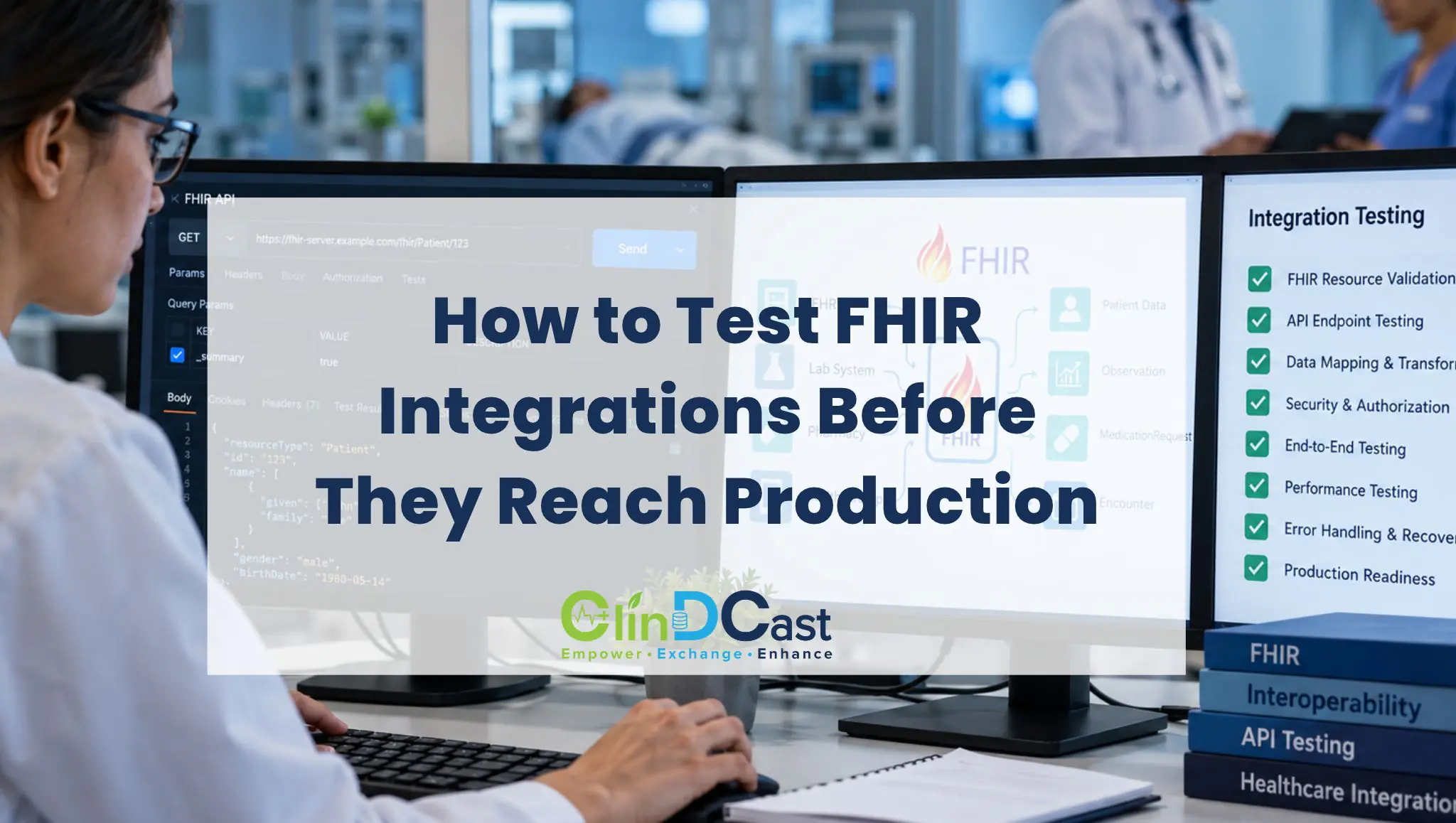
How to Test FHIR Integrations Before They Reach Production is a critical consideration for healthcare IT teams aiming to ensure reliable data exchange and seamless interoperability. A systematic testing strategy enables discovering integration defects, validating FHIR resources, testing APIs functionality, and assessing application’s security and performance before deployment. The combination of functional, data validation, security, and performance testing, as well as end-to-end testing, will reduce healthcare companies’ risks of exposing sensitive patient information and ensure FHIR resources in accordance with requirements before launch.
Why Is FHIR Integration Testing Important?
FHIR Integrations connect healthcare systems that may have differing architectures, data models, terminology, and implementation guidelines. Systems that use the same version of FHIR may have different resource profiles, available operations, and business rules.
Effective FHIR integration testing helps healthcare organizations:
- Improve data accuracy: Ensure clinical information is exchanged correctly.
- Strengthen interoperability: Verify that connected systems interpret FHIR resources consistently.
- Protect patient information: Identify security and authorization weaknesses.
- Reduce deployment risks: Detect defects before they affect production.
- Maintain workflow reliability: Minimize data exchange failures and disruptions.
1. Validate FHIR Resources and Data Structures
FHIR resources such as Patient, Practitioner, Encounter, Observation, and MedicationRequest have well-defined data element structures. Nevertheless, the resource that is structurally valid might not be sufficient for a particular implementation guide or healthcare process.
Testing should verify the following:
- Required fields and data types.
- Resource references and relationships.
- Terminology bindings and clinical codes.
- Identifiers, dates, and measurement formats.
- FHIR profiles and implementation guide requirements.
Example: An Observation resource may have a valid laboratory finding but an incorrect patient identifier. Resource validation and reference validation can help identify this issue prior to the information being relayed to another clinical application.
FHIR validation tools can identify structural issues and profile violations that can enhance the quality of the data and facilitate standardized healthcare exchanges.
2. Test FHIR REST API Endpoints
FHIR uses RESTful APIs to support operations such as creating, retrieving, updating, and searching healthcare resources.
API testing verifies that these operations behave as expected and return appropriate responses.
Important test scenarios include:
- HTTP methods: Validate supported GET, POST, PUT, and PATCH operations.
- Status codes: Check successful responses and error conditions.
- Resource retrieval: Confirm that the correct records are returned.
- Search functionality: Test search parameters, filtering, and pagination.
- Error handling: Validate responses to invalid requests and missing resources.
- Duplicate prevention: Ensure repeated submissions do not create unintended records.
Tools such as Postman can help testers validate FHIR API endpoints and automate repeatable test scenarios.
Teams should also verify that errors follow the expected response format, including FHIR OperationOutcome resources where applicable.
3. Verify Healthcare Data Mapping and Transformation
Healthcare integration solutions often transform information from HL7 v2 messages, legacy EHRs, and other proprietary applications into FHIR resources.
Testing is needed to ensure that the transformed information maintains its clinical meaning and integrity.
For example, converting a laboratory result into a FHIR Observation requires accurate mapping of:
- Patient and encounter identifiers.
- Observation codes and terminology.
- Result values and units of measurement.
- Timestamps and time zones.
- Relationships between healthcare resources.
Testers should also evaluate the presence of missing, incomplete, or conflicting data.
By comparing the source data with the resulting FHIR resources, testers can ensure that there are no mapping errors at the time of deployment. Accurate healthcare data mapping is critical to enable reliable healthcare data exchange between disparate systems.
4. Perform FHIR Security and Authorization Testing
FHIR integrations have the potential to process protected health information (PHI) and thus must be tested for security before release into production.
Implementations using OAuth 2.0 and SMART on FHIR should be tested to ensure that the authentication flows, access tokens, permissions, and authorization scopes are properly functioning.
Security testing should include:
- Invalid credentials and expired access tokens.
- Unauthorized requests to protected resources.
- Access restrictions based on assigned permissions.
- Secure transmission of sensitive healthcare data.
- Appropriate handling of credentials and application logs.
Example: An application authorized to retrieve patient demographics should not automatically gain access to unrelated clinical information.
Negative authorization tests help verify that access controls are enforced properly.
Testing should use synthetic or appropriately de-identified patient data in approved non-production environments.
5. Conduct End-to-End FHIR Integration Testing
Individual APIs may function correctly while the complete healthcare workflow still fails.
End-to-end testing evaluates whether connected systems exchange and process information as intended.
A typical test scenario may involve:
- Creating or retrieving a patient record.
- Recording a clinical encounter.
- Adding a clinical observation.
- Transmitting the information to another application.
- Verifying that the receiving system processes the information correctly.
- Confirming that subsequent updates are reflected as expected.
Testing should also ensure references to resources are accurate and that errors are properly reported.
Teams should test async processing, notifications, and FHIR subscription patterns, if supported by the implementation, as a means to identify issues of interoperability that individual API tests might miss.
6. Evaluate Performance and Error Handling
FHIR integration testing should assess how systems behave under realistic workloads and unexpected failures.
An integration that performs well with a small dataset may struggle when processing large volumes of clinical information.
Performance testing should evaluate:
- API response times.
- Concurrent requests and transaction volumes.
- Search performance and pagination.
- Rate limiting and server throttling.
- Resource consumption and scalability.
Error-handling tests should cover:
- Network interruptions and timeouts.
- Temporary FHIR server unavailability.
- Retry mechanisms after transient failures.
- Recovery after service restoration.
- Prevention of duplicate records.
Distinguishing temporary failures from permanent errors is important for maintaining reliable healthcare data exchange.
All load and stress testing should take place in an authorized non-production environment.
7. Automate FHIR Regression Testing
FHIR integrations are affected by changes in EHR systems, API, their implementation guides, and clinical workflows.
Such modifications may introduce defects in previously functioning processes. Automated regression testing makes it possible to re-test existing functionality and verify that it works correctly.
Test suites can validate:
- FHIR resource structures.
- API requests and responses.
- Data mapping and transformation.
- Authentication and authorization.
- End-to-end clinical workflows.
- Error handling and recovery.
Integrating automated FHIR testing into continuous integration and continuous delivery (CI/CD) pipelines allows teams to identify defects earlier and maintain consistent quality checks throughout the software development lifecycle.
Useful FHIR testing tools include:
- HAPI FHIR Validator: Validates resources against supported profiles and implementation guides.
- Postman: Tests API endpoints, requests, and responses.
- Inferno: Supports conformance testing for applicable FHIR implementation requirements.
- Touchstone: Provides conformance testing for supported FHIR specifications and test suites.
Tool selection should depend on the FHIR version, implementation requirements, and available test suites.
FHIR Integration Production-Readiness Checklist
Before deploying a FHIR integration, healthcare IT teams should confirm that the following requirements have been met:
- FHIR resources meet applicable validation requirements.
- API endpoints and error responses work correctly.
- Data mapping preserves clinical meaning and identifiers.
- Authentication and authorization controls have been tested.
- End-to-end clinical workflows pass representative test scenarios.
- Performance and recovery meet defined requirements.
- Automated regression tests pass.
- Monitoring, logging, and rollback procedures are ready.
Strengthen Healthcare Interoperability with ClinDCast
The reliable FHIR integrations allow for safe clinical data exchange, simplified EHR connection, and overall better healthcare interoperability. The testing strategies that healthcare companies implement while designing such solutions help them detect integration problems at an early stage and reduce production costs.
ClinDCast helps healthcare organizations navigate complex healthcare IT integration and interoperability challenges through expertise in EHR integration, FHIR interoperability, healthcare data exchange, and IT consulting. By focusing on integration quality, system reliability, and secure data connectivity, organizations can build a stronger foundation for connected healthcare.
Partner with ClinDCast to support your healthcare interoperability initiatives and build more reliable connections across healthcare systems.