










One of the most important digital transformation projects for any healthcare organization is the implementation of Epic EHR. Despite Epic’s strong capabilities in clinical care, revenue cycle, and operational workflows, many hospitals are unable to fully benefit from it because of preventable implementation errors.
These errors frequently result in long-term system inefficiencies, financial disruption, clinician burnout, delayed go-lives, and compliance risks. Leadership teams can take a proactive, methodical approach to successful implementation by being aware of the areas where most organizations struggle.
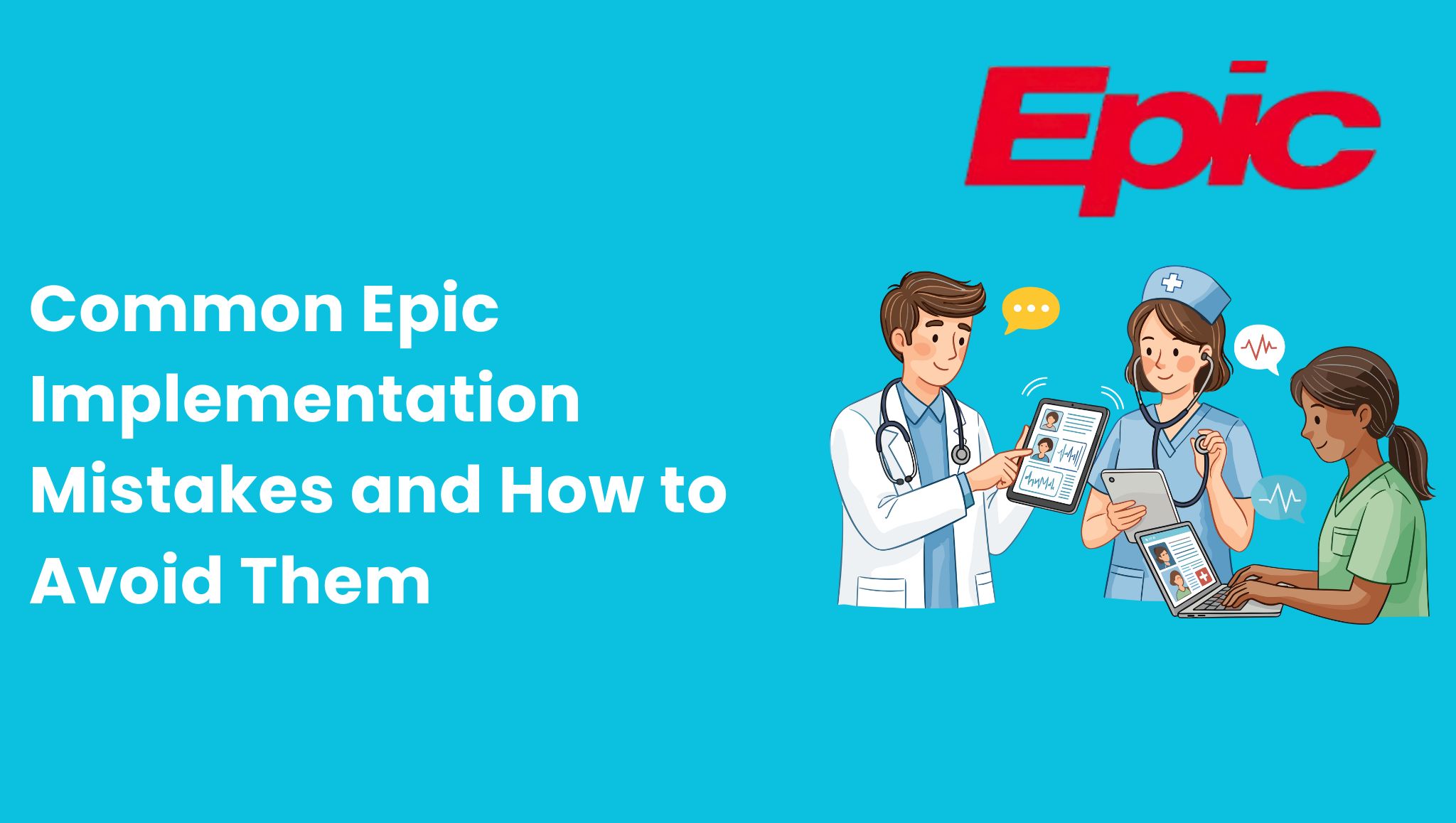
This blog explores the most Common Epic Implementation Mistakes and How to Avoid Them can avoid them using proven best practices.
The Most Common Epic Implementation Mistakes Hospitals Make
1. Inadequate Pre-Implementation Planning
One of the most detrimental Epic implementation errors is poor planning. Before coordinating IT, clinical teams, and leadership on a common plan, many organizations start configuration and building tasks. Later in the project, this leads to misunderstandings, misplaced priorities, and unchecked scope expansion.
Common risks of weak planning include:
a) Unclear project goals and success metrics
b) Unrealistic budgets and timelines
c) Weak governance and accountability
d) Misalignment between IT and clinical leadership
How to Avoid It:
A formal Epic readiness assessment that covers people, processes, data, and technology should be the first step for organizations. Clinical, financial, and compliance departments must all document enterprise-wide goals. Before any technical build starts, a robust governance structure with executive sponsorship, steering committees, and clear escalation paths must be established.
2. Underestimating Data Migration Complexity
Epic data migration is frequently oversimplified and undervalued. Legacy systems use antiquated coding standards, incomplete histories, and inconsistent data formats. Patient safety and revenue integrity may be jeopardized if this data is transferred into Epic without the necessary validation.
Major risks include:
a) Incomplete medication and allergy histories
b) Inaccurate problem lists
c) Billing and coding discrepancies
d) Reporting and analytics inconsistencies
How to Avoid It:
A methodical approach to data migration is crucial. Prior to the final cutover, this involves several iterations of data cleansing, clinical validation, parallel system testing, and reconciliation. The highest level of scrutiny must be applied to high-risk clinical data. Data integrity is preserved long after go-live thanks to formal data governance.
3. Weak Clinical and Operational Stakeholder Involvement
IT-driven epic implementations frequently fall short of real-world clinical workflows. Adoption suffers and operational inefficiencies become ingrained in routine practice when doctors and nurses are not actively involved in system design.
This results in:
a) Increased documentation burden
b) Reduced provider productivity
c) Higher clinician frustration
d) Resistance to system adoption
How to Avoid It:
At every stage of the rollout, clinical leadership has to be there. Clinician leaders and nursing super-users need to be not only present but also deeply involved in the designing of workflows, setting up of order configurations, and testing rounds. Their engagement is the guarantee that Epic is not just a tool for imagined processes but it is really helping in the care of patients in the clinic.
4. Inadequate Epic Training Strategy
Many organizations treat training as a one-time event instead of a continuous enablement process. Generic training programs fail to prepare users for real-world complexity and role-specific workflows.
Common training failures include:
a) Lack of role-based learning paths
b) Minimal hands-on practice
c) Poor knowledge retention
d) Heavy post go-live support dependency
How to Avoid It:
Epic training should definitely be based on roles and reflect real-life situations. Simply by doing the classroom training, simulation exercises, and using digital learning modules, the adoption rate is greatly enhanced. Support right at the elbow during the go-live and refresher training after 60–90 days are the elements that guarantee the continuation of the productivity and the confidence of the users at a broad level.
5. Poor Revenue Cycle Integration Planning
Revenue cycle workflows are often treated as secondary to clinical workflows during implementation. This results in immediate financial disruption once Epic goes live.
This leads to:
a) Charge capture breakdowns
b) Eligibility verification failures
c) Prior authorization delays
d) Increased claim denials
How to Avoid It:
Healthcare revenue cycle processes need to be thoroughly planned and tested from start to finish. The patient registration, coding, billing, and reimbursement departments are all included in this. To guarantee that the cash flow will not be interrupted, it is necessary to carry out full-cycle testing prior to the actual implementation of the system. It is also necessary for the clinical and financial teams to work together very closely during the configuration stage.
6. Ignoring Interoperability and Third-Party Integrations
Epic is not a system that functions alone. In fact, it has to be compatible with various systems in order to transfer data, including labs, imaging systems, pharmacies, medical devices, and external health networks. If the integration is not well thought out, it will lead to scattered patient data and tedious manual processes.
Failure risks include:
a) Delayed lab and imaging results
b) Pharmacy integration errors
c) Device connectivity issues
d) Incomplete patient records
How to Avoid It:
A formal strategy for interoperability should be developed based on HL7 and FHIR standards. It is recommended that every interface be subjected to performance, volume, and failure testing prior to go-live. A robust interface surveillance after the release guarantees continuous stability.
7. Understaffed Post Go-Live Support
Many organizations assume that stability will occur on its own and cut support too soon after go-live. Unresolved problems, care delivery delays, and increasing clinician annoyance result from this.
Typical outcomes include:
a) High ticket backlogs
b) Slow issue resolution
c) Workflow disruptions
d) Reduced patient throughput
How to Avoid It:
Health care businesses are advised to maintain a command center support system for at least 30 to 90 days after the go-live. System performance, clinician productivity, and documentation accuracy should be continuously monitored by a team of committed Epic analysts, trainers, and application support.
8. No Post-Implementation Optimization Strategy
Go-live is not the finish line. Without structured optimization, organizations continue using inefficient workflows and fail to unlock Epic’s full capabilities.
Common long-term issues include:
a) Inefficient documentation workflows
b) Underutilized reporting tools
c) Alert fatigue
d) Limited automation adoption
How to Avoid It:
It is necessary to maintain formal 90-day and 180-day optimization review sessions. Process optimization, reporting upgrades, decision support tuning, and performance improvement are the main topics of discussion at these meetings. The real long-term return on investment comes from continuous optimization.
9. Weak Change Management and Communication
When humans are not assisted during the change process, technological transformations fall short. Uncertainty, resistance, and disengagement are all caused by poor communication within the company.
Symptoms include:
a) User resistance
b) Shadow IT workarounds
c) Declining morale
d) Leadership disengagement
How to Avoid It:
Technical implementation must be accompanied by an organized change management program. Throughout the course of the project, this entails regular leadership communication, progress reports, feedback systems, and user involvement programs.
10. Choosing the Wrong Epic Implementation Partner
Instead of considering capability, many organizations choose their implementation partners primarily on the basis of cost. This frequently results in protracted stabilization times, rework, and skill gaps.
Key risks include:
a) Limited Epic expertise
b) Underqualified resources
c) Delivery accountability issues
d) Weak post go-live support models
How to Avoid It:
Epic certification depth, healthcare domain expertise, revenue cycle knowledge, and post-go-live optimization capabilities must all be taken into consideration when evaluating partners. Long-term success and accountability are guaranteed by outcome-based delivery models and clearly defined service levels.
Why Choose ClinDCast
Based on actual healthcare delivery experience, ClinDCast provides targeted Epic setup, optimization, and support services. In clinical, financial, and operational workflows, we assist clients in lowering risk, stabilizing operations, and achieving quantifiable results.
Conclusion
Strong planning, focused execution, and ongoing improvement are necessary to avoid frequent Epic implementation errors. The people, workflows, governance, and long-term optimization model that support the technology are just as important to its success as the technology itself.
Stronger clinician satisfaction, financial stability, and better patient outcomes are attained by healthcare organizations that approach Epic with an organized implementation strategy and a continuous improvement mindset.